The use of artificial intelligence in robotics has changed many industries. Now, robots can understand natural language and move around on their own in complex places.
Robots used to be simple and only good for one thing. But, thanks to AI technology, they can now follow human actions, listen to speech, and even understand behavior. This makes them better at working together and getting things done.
This teamwork is changing many areas, from doing household chores to handling big industrial jobs. It makes things more efficient and productive.
Key Takeaways
- AI integration has transformed robots into sophisticated collaborators.
- Robots now understand natural language and navigate complex environments.
- The collaboration enhances efficiency and productivity across sectors.
- Advances in AI technology have enabled robots to recognize and react to human behavior.
- The future holds even more sophisticated robots capable of complex tasks.
Introduction to AI-Human-Robot Interaction
AI-human-robot interaction is changing the world fast. It’s making robots better at understanding and talking to humans. This is thanks to AI technology.
Working together with humans is key in today’s industry. As AI technology gets better, robots can help humans do their jobs better. This makes things more efficient and productive.
Definition of AI-Human-Robot Collaboration
AI-human-robot collaboration means humans and robots working together with AI technology. Robots can now do tasks that need human smarts. This includes understanding speech, seeing objects, and making choices.
Humanoid robots are being used more in places like factories and hospitals. They help with tasks that need human-like skills and interaction.
Importance in Modern Industry
AI-human-robot collaboration is changing many industries. It’s making things like manufacturing, healthcare, and logistics better. Robots working with humans can make things more efficient, cheaper, and better for customers.
Using AI technology in robots also helps companies keep up with market changes and customer needs. This makes businesses more adaptable and responsive.
Historical Context of Robotics and AI
Understanding the history of robotics and AI is key to seeing their current uses and future possibilities. Robotics has evolved from simple machines to advanced AI systems. This journey has been long and has changed a lot.
Evolution of Robotics Technology
The growth of robotics has seen big steps forward in mechanical engineering and computer science. At first, robots were used for tasks like assembly line work. They were precise but did the same thing over and over.
Later, robots got smarter, adding sensors and complex programs. This let them do different tasks. The introduction of collaborative robots (co-bots) was a big step. Now, robots can work with people safely, thanks to better sensors and AI.
- Early industrial robots focused on repetitive tasks.
- Advancements in sensor technology improved robot versatility.
- Integration of AI enabled more complex tasks and decision-making.
Milestones in AI Development
AI has reached many important points in its growth. From the start of machine learning to the creation of deep learning, AI has grown a lot.
Some major highlights include:
- The first neural networks were developed.
- Natural language processing (NLP) saw big improvements.
- AI started being used in fields like healthcare and finance.
AI and robotics working together has opened new paths for automation. This mix has let robots do complex tasks that need to be smart and adaptable. This partnership is set to keep pushing the boundaries of what’s possible.
The Role of AI in Enhancing Robotics
AI and robotics have merged, creating robots that learn and adapt like humans. This mix has made robots more efficient and able to tackle complex tasks. Tasks that were once thought only humans could do.
Robots can now learn from their experiences and adjust to new situations. This is thanks to machine learning and advanced AI algorithms. These tools help robots understand and interact with their world more intelligently.
Machine Learning and Robotics
Machine learning has been key in improving robotics. It lets robots learn from data and get better over time. With neural networks and other techniques, robots can now spot patterns, make choices, and do tasks that need precision and flexibility.
In ai robot development, machine learning helps robots learn from their environment. They adapt to new situations, making tasks like assembly, navigation, and object recognition easier.
AI Algorithms in Robotics
AI algorithms are essential for modern robotics. They let robots understand and interact with their world in a meaningful way. These algorithms help robots process sensory data, make decisions, and perform tasks that need intelligence and flexibility.
The goal of creating human-like robots shows how AI algorithms are enhancing robotics. By allowing robots to mimic human behavior, AI is making robots more natural and intuitive in their interactions with humans.
The combination of AI and robotics could change many industries. From manufacturing and healthcare to transportation and education, the future looks promising. As AI keeps getting better, we’ll see even more advanced and capable robots.
Types of AI-Human-Robot Collaboration
Technology is getting better, and how AI, humans, and robots work together is changing. There are many ways they collaborate, each using the best of human skills and robotic abilities.
Collaborative Robots (Co-bots)
Collaborative robots, or co-bots, work with humans to make tasks more efficient. They have advanced sensors and AI to understand their surroundings. This lets them do complex jobs that need both precision and human insight.
In factories, co-bots help with tasks like assembly and welding. They can learn from humans and handle new tasks well, making them very useful in changing work environments.
Autonomous Robots in Workplaces
Autonomous robots can do tasks on their own, without needing humans. They are great for jobs that are repetitive or need a lot of precision. These robots can move around complex spaces, avoid things, and change their actions based on what they see.
In workplaces, autonomous robots help with things like moving goods and cleaning. They work alone, which helps companies save money and work better.
Using both co-bots and autonomous robots in work is a big step forward in futuristic technology. It lets businesses use AI, humans, and robots together in new ways. As these technologies get better, we’ll see even more cool uses in different fields.
Benefits of Integrating AI with Human Workers
The mix of AI and human workers brings new efficiency and innovation. As more industries use artificial intelligence and robotics, work gets safer and more productive. AI lets humans focus on creative and complex tasks, while it handles the rest.
Increased Efficiency and Productivity
AI and human workers together boost efficiency and productivity. AI quickly sorts through huge amounts of data, giving insights for better decisions. When humans add their expertise, results improve.
In manufacturing, humanoid robots with AI help humans. They take over tasks that are too risky or boring. This makes production lines run smoother.
AI also makes workflows better by predicting when things need fixing and managing supplies. This cuts down on downtime and makes resources go further. Businesses can produce more with less waste, improving their profits.
Enhanced Safety and Risk Mitigation
AI and humans working together also make workplaces safer. AI robots can do jobs in dangerous places, keeping humans safe. This is true in construction, mining, and nuclear work.
AI robots can also watch over workplaces, spotting dangers early. This keeps employees safe and saves money and reputation from accidents. As AI gets better, it will play an even bigger role in keeping workplaces safe.
Challenges in AI-Human-Robot Collaboration
Integrating AI into human-robot teams comes with its own set of hurdles. As more companies use AI with robots, they face a mix of ethical and technical issues.
Ethical Considerations
One big challenge is making sure AI is fair and transparent. AI technology needs to be built with fairness, openness, and accountability in mind. If AI is biased, it can cause unfair results, harming both efficiency and human workers’ well-being.
Also, using machine learning in robots raises privacy and security concerns. Robots need access to personal data, which must be kept safe from hackers and misuse.
Technological Limitations
AI-human-robot teams also face tech limitations. Current AI technology struggles to grasp complex human actions and adapt to new situations.
Integrating machine learning with robots is still a work in progress. We need better algorithms that let robots learn and adapt on their own, without needing constant updates.
Overcoming these obstacles is key to making AI-human-robot teams work well. By tackling these challenges, companies can improve productivity, safety, and innovation.
The Future of AI-Human-Robot Interaction
Advances in AI are changing how humans and robots work together. As we look ahead, we’ll see more advanced AI and robots in many fields. This will change how we interact with them.
Trends in AI Development
Several trends in AI will shape the future of human-robot interaction. Machine learning and deep learning are key. They let robots learn and get better over time.
Also, we’re seeing better human-robot interfaces. These make it easier for humans and robots to talk and work together. We’re using voice commands, gestures, and facial expressions to control robots.
Potential Impact on Job Markets
Robots and AI will change job markets a lot. Some jobs might disappear, but new ones will appear too. Jobs in AI, robotics, and maintenance are likely to grow.
To help workers, we need to invest in education and retraining programs. These programs should teach about AI, robotics, and new tech. This way, workers can adapt to the changing job world.
Industries Transforming Through AI-Human-Robot Collaboration
Manufacturing and healthcare are changing a lot thanks to AI-human-robot teamwork. This teamwork boosts productivity and creates new ways to innovate.
Manufacturing Sector Innovations
The manufacturing world is getting a big boost from AI-human-robot teamwork. Robots are now doing complex assembly tasks, making things more precise and faster. For example, collaborative robots (co-bots) work with humans to make production more efficient.
AI in manufacturing also brings predictive maintenance. Robots and machines can forecast when they need a check-up. This cuts down on downtime and boosts productivity.
| Innovation | Description | Impact |
|---|---|---|
| Collaborative Robots | Robots designed to work alongside humans | Enhanced Efficiency |
| Predictive Maintenance | AI-driven maintenance prediction | Reduced Downtime |
| Advanced Assembly Tasks | Complex tasks performed by robots | Increased Precision |
Healthcare Robotics Advancements
The healthcare field is seeing big changes thanks to AI-human-robot teamwork. Robots help in surgeries, care for patients, and aid in rehabilitation. For instance, robotic surgery systems let surgeons do complex operations with more accuracy and less invasion.
Robots also help in patient care, offering companionship and aid. This improves patients’ experiences and recovery times.
The future of AI-human-robot teamwork in healthcare is bright. We can expect big steps forward in personalized medicine and robotic-assisted therapy.
Case Studies of Successful Collaborations
Many leading companies have seen great success with AI-human-robot teamwork. This teamwork has boosted productivity and safety in many fields.
Examples from Leading Tech Companies
BMW and Amazon are leading the way in using AI and robots together. BMW uses robots in their assembly lines to help humans work better and make fewer mistakes.
Amazon also uses AI robots in its warehouses. These robots help pack and ship orders faster. They use smart AI to find products and get them ready for shipping.
Lessons Learned from Implementation
Using AI and robots together has taught us a lot. One important thing is the need for proper training for humans. They need to know how to work well with the robots.
Another key lesson is the importance of continuous monitoring and evaluation. This helps find ways to make the teamwork even better.
- Implementing AI-human-robot collaboration requires a strategic approach.
- Continuous training and evaluation are key to successful collaboration.
- The integration of AI with robotics enhances productivity and safety.
Training and Skills for Human Workers
Now, human workers need to have both technical and soft skills to work well with robots. As AI technology gets better, it’s crucial to have a team that can work well with humanoid robots.
Essential Skills for Collaboration
To work well with robots, humans must know what AI technology can and can’t do. They need to know how to program, use, and fix robots. They also need to solve problems that come up when working together.
Important skills for humans include:
- Technical skills to operate and maintain robotic systems
- Problem-solving skills to address technical issues
- Communication skills to work effectively in human-robot teams
- Adaptability to adjust to new technologies and workflows
Training Programs and Resources
There are many training programs and resources to help humans get the right skills. These include:
| Training Program | Description | Provider |
|---|---|---|
| Robotics Operation and Maintenance | Hands-on training on operating and maintaining industrial robots | Robotics Inc. |
| AI and Machine Learning Fundamentals | Online course covering the basics of AI and machine learning | AI Academy |
| Human-Robot Collaboration Workshop | Workshop focusing on strategies for effective human-robot collaboration | Collaboration Experts |
By using these training programs, humans can learn the skills needed to work well with humanoid robots. This helps in the success of AI projects.
Measuring Success in AI-Human-Robot Projects
It’s key to check how well AI-human-robot projects work. This helps us see if they make things more productive and efficient. To do this, we need clear ways to measure their success.
Key Performance Indicators
Key Performance Indicators (KPIs) are ways to check if AI-human-robot projects are doing well. Important KPIs include:
- Productivity rates: Looking at how well tasks are done together.
- Error reduction: Seeing if AI and robots help lower mistakes.
- System uptime: Checking if robotic systems are always ready to go.
These KPIs show the real benefits of working together with AI and robots.
Evaluation Metrics
Evaluation metrics give us a deeper look at how well projects are doing. They include:
- Return on Investment (ROI): Looking at the money made from AI-human-robot projects.
- User satisfaction: Checking if people like and find robots easy to use.
- Safety metrics: Watching how AI and robots affect safety at work.
By using KPIs and evaluation metrics together, we get a full picture of success.
Machine learning and robotics help us measure success better. They let us improve how we work together and get more done.
Regulatory and Compliance Issues
As AI and robots work together more, governments face a big challenge. They need to make rules for this new tech. But, the mix of AI and robots brings new problems that old laws don’t cover.
The rise of human-like robots and AI robot development makes us rethink our laws. We need to look at safety, who’s to blame, and what’s right and wrong.
Current Regulations in AI and Robotics
Right now, laws for AI and robots are changing. Different places have different ways to handle this tech. For example, the European Union has rules for AI safety and being open, while the U.S. focuses on specific areas.
- Standards for AI safety and performance
- Guidelines for ethical AI development
- Regulations regarding liability and accountability
These laws try to make sure AI and robots work together safely and right.
Future Legislative Trends
As AI gets better, we’ll see new laws. They will focus on a few main things. These include:
- More safety rules for AI
- Tighter rules for data privacy
- Clearer rules on who’s responsible for AI mistakes
New laws will help shape the future of AI and robots working together. They will make sure this tech is both new and responsible.
By understanding and following these laws, everyone can deal with the challenges of AI and robots. This will help create a safer and more effective team-up.
The Role of Public Perception in Adoption
The adoption of AI-human-robot collaboration depends a lot on public perception. As industries use more robots and AI, it’s key to understand and tackle public worries.
Understanding Public Concerns
People worry about job loss and safety with AI-human-robot collaboration. They fear robots and AI might take many jobs. To fix this, we need to educate and be open about the good and bad sides of AI human robot work.
While AI and robots might replace some jobs, they also open up new ones. They help in keeping workplaces safe by doing risky tasks.
Strategies for Public Engagement
It’s vital to engage the public well to make them see AI-human-robot collaboration in a good light. We should educate, show off the tech, and let the community help shape it. This way, we can gain trust and encourage more use of this tech.
Also, sharing success stories and the good things AI-human-robot collaboration does can change minds. We can do this through the media, events, and working with influencers.
Building Trust Between Humans and Robots
In the world of AI, human-robot teamwork, trust is key. As we add artificial intelligence and humanoid robots to many fields, building trust is crucial. It’s what makes teamwork between humans and robots successful.
Importance of Trust in Collaboration
Trust is the base of good human-robot teamwork. When humans trust robots, they work better together. This leads to more done and better results. Trust also makes humans more open to new robot systems and tech.
Transparency and explainability help build trust. Transparency means robots can clearly show how they work and make decisions. Explainability goes further by explaining why robots make certain choices.
Techniques to Foster Trust
There are ways to build trust between humans and robots:
- Use clear and understandable AI algorithms
- Make robot interfaces easy to use
- Teach humans about robot systems
- Ask for feedback to keep improving teamwork
The table below shows some key techniques and their benefits:
| Technique | Benefits |
|---|---|
| Transparency | Helps humans understand and trust robot decisions |
| Explainability | Gives insights into robot decision-making |
| User-friendly interfaces | Makes humans feel more comfortable with robots |
| Training and support | Boosts teamwork and productivity |
By using these methods and valuing trust, we can make human-robot teams work better. As artificial intelligence gets better, robots will become more trusted partners in many areas.
Innovations in AI and Robotics Research
Research in AI and robotics is changing industries and how we work. AI technology and machine learning are making robots smarter. These robots can now do complex tasks with great precision.
Top schools like MIT and Stanford University are leading these changes. They focus on machine learning and robotics. Their work leads to new technologies used in many fields.
Leading Academic Institutions
Schools are key in pushing AI and robotics forward. They give researchers the tools to create new tech. They work on better AI, more independent robots, and how humans and robots interact.
These schools also work with companies to make their research useful. For example, ai technology has made factories more efficient. It has also made cars and planes safer.
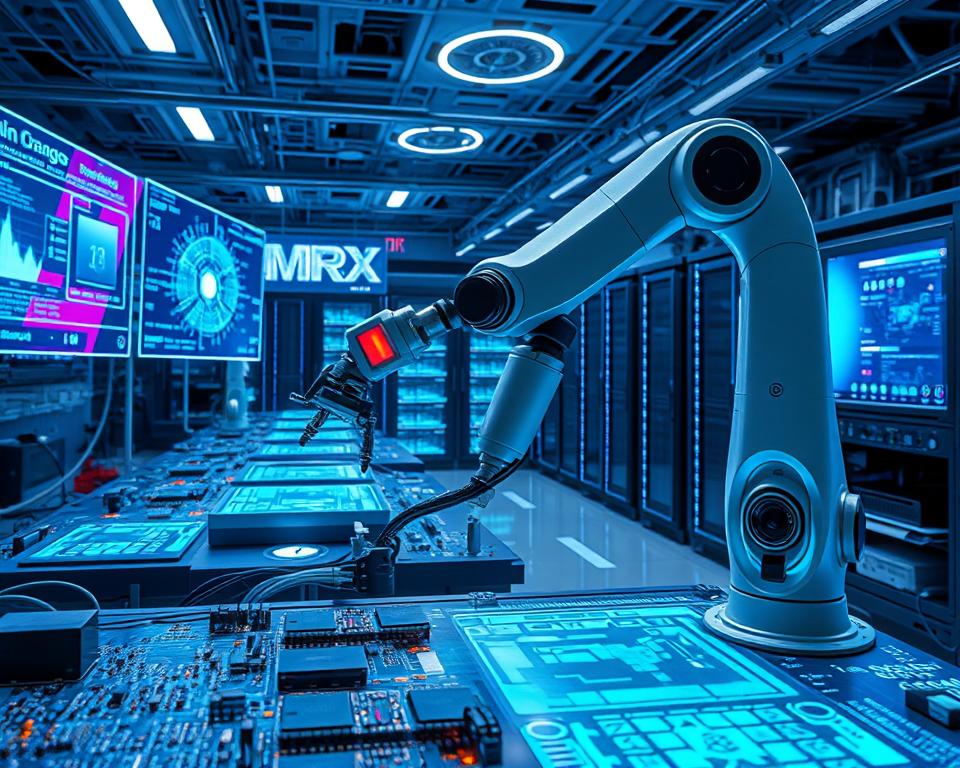
Breakthrough Technologies on the Horizon
The future of AI and robotics looks bright. Robots that can learn and get better on their own are coming. They use machine learning to improve.
We also expect robots to understand and talk to humans better. And robots will see and understand their world more clearly. These changes will make healthcare, making things, and moving people better.
Conclusion: The Path Forward for AI-Human-Robot Collaboration
The future of AI-human-robot collaboration is exciting. It will change many industries thanks to AI progress and more robots in work. As robots get smarter, we can work better together, making things more efficient and effective.
Key Takeaways
AI and humans working together has brought big benefits. We see more done in less time. But, we also face issues like ethics and tech limits. We need to solve these to use AI and robots to their fullest.
Future Directions
We must all work together to improve AI and robots. This will help us use their strengths to grow and innovate. By doing this, we can make AI-human-robot collaboration a big success.
FAQ
What is AI-human-robot collaboration?
AI-human-robot collaboration is when artificial intelligence (AI) helps robots work with humans. This makes things more efficient and productive.
How is AI used in robotics?
AI helps robots learn and adapt. This lets them do complex tasks better in many fields.
What are the benefits of AI-human-robot collaboration?
Working together, humans and robots can do more and better. This leads to safer and higher-quality work in places like factories and hospitals.
What are the challenges associated with AI-human-robot collaboration?
There are ethical issues like fairness and bias. Also, technology needs to get better for robots to work well with humans.
How can human workers develop the skills needed to collaborate with robots?
People can learn by taking courses. These teach them how to work with robots and understand AI.
What are the different types of AI-human-robot collaboration?
There are co-bots and autonomous robots. Co-bots work with humans, while autonomous robots do tasks on their own.
How can the success of AI-human-robot projects be measured?
Success is checked with things like how well they work together. This helps make things better over time.
What are the regulatory and compliance issues associated with AI-human-robot collaboration?
Rules and laws are needed to keep things safe. This is important for robots that look like people and new tech.
How can public perception be addressed in the adoption of AI-human-robot collaboration?
Education helps people understand the good things about robots. This can make them feel more positive about new tech.
Why is trust important in AI-human-robot collaboration?
Trust lets humans and robots work well together. Being open and clear about how things work helps build trust.