Did you know the global market for artificial intelligence humanoids is growing fast? This is thanks to new tech in robotics and AI. Humanoid robots are in demand for jobs like customer service, healthcare, and education.
Creating an AI humanoid is a big challenge. It needs careful planning from start to finish. You must know a lot about both the robot’s body and its AI brain.
This guide will show you how to make an AI humanoid. We’ll cover the main parts and the big hurdles you might face.
Key Takeaways
- Understanding the complexity of building an AI humanoid
- Identifying the key components involved in the process
- Recognizing the importance of integrating mechanical and AI aspects
- Learning the step-by-step guide to building an AI humanoid
- Appreciating the applications of AI humanoids in various industries
Understanding AI Humanoids
Humanoid robots have changed a lot over time. AI technology is key in their growth. These robots look and act like humans, thanks to AI and robotics.
Definition and Concept
AI humanoids are robotic humanoids that use AI to do tasks that need human smarts. They can understand language, see faces, and make choices. The idea of humanoid robots has been around for decades. But AI has made them much better.
These robots look like humans and move like them too. This makes them better at working with people and their surroundings.
History of AI Humanoid Development
The making of AI humanoids has taken a long time. Early versions were simple and could only do basic things. But, with AI and robotics getting better, we now have more advanced robots.
“The future of robotics is not just about creating machines that can perform tasks, but about creating machines that can interact with humans in a meaningful way.”
Big steps in AI humanoid development include Sophia and Atlas. Sophia was made by Hanson Robotics, and Atlas by Boston Dynamics. These robots show how AI humanoids can be used in many ways.
Applications in Various Industries
AI humanoids are used in many fields because they are so versatile. Some main areas include:
- Manufacturing: They can do assembly, check products, and work with people.
- Healthcare: They help with patient care, keep the elderly company, and aid in rehab.
- Entertainment: They are used in theme parks, movies, and museums for interactive fun.
| Industry | Application | Benefits |
|---|---|---|
| Manufacturing | Assembly, Inspection | Increased Efficiency, Precision |
| Healthcare | Patient Care, Rehabilitation | Improved Patient Outcomes, Companionship |
| Entertainment | Interactive Exhibits, Performances | Enhanced Experience, Engagement |
As AI humanoid tech keeps getting better, we’ll see new uses in many areas.
Key Components of an AI Humanoid
Every AI humanoid has three main parts: mechanical structure, sensor systems, and software intelligence. These elements work together. They help the humanoid do complex tasks, interact with its surroundings, and adapt to new situations.
Mechanical Structure
The mechanical structure is key for the humanoid’s movement and interaction. It includes the body’s design, limbs, joints, and movable parts. A good design lets the humanoid do tasks that need precision and flexibility.
Key considerations in mechanical structure design include:
- Durability and robustness
- Flexibility and range of motion
- Weight distribution and balance
For example, robotics companies like Boston Dynamics have made advanced structures. These allow their humanoids to walk, run, and even do acrobatics.
Sensor Systems
Sensor systems give the AI the feedback it needs. They include cameras, lidar, GPS, and tactile sensors. This data helps the humanoid see its environment, track its movement, and adjust its actions.
Types of sensors used in AI humanoids include:
| Sensor Type | Function | Example |
|---|---|---|
| Camera | Visual perception | Object recognition |
| Lidar | Distance measurement | Obstacle detection |
| Tactile sensors | Touch and pressure sensing | Grasping objects |
Software Intelligence
Software intelligence lets the humanoid learn, adapt, and make decisions. It uses machine learning algorithms and artificial intelligence. This way, the humanoid can understand its environment and respond correctly.
“The development of AI that can learn and adapt is crucial for creating humanoids that can interact with humans in a meaningful way.” –
The software of an AI humanoid is built with programming languages and frameworks. The goal is to create AI models that can handle and respond to complex data.
Designing the Humanoid’s Appearance
Designing a humanoid robot’s look is a big challenge. It’s about finding the right mix of beauty and usefulness. How a robot looks can really affect how people feel about it.
Aesthetics and User Interaction
The look of a humanoid robot is key to how people see and use it. A robot that looks good can make users feel more positive and engaged. For example, futuristic humanoids with cool designs and faces can make talking to them fun.
User-centered design is important for making robots that look good and are easy to use. Designers should think about what users want and need. This way, robots can be both beautiful and useful.
Ergonomics and Functionality
Ergonomics is also a big deal in robot design. The robot’s shape and movement should make it easy to use. Humanoid robots need to be made with their purpose in mind, like helping in service or healthcare.
- Good design means making robots that feel natural to interact with.
- It’s also important for the robot to do its job well.
- Using AI humanoid technology adds cool features like learning and adapting.
By paying attention to both looks and function, designers can make robots that are both attractive and useful.
Choosing the Right Technology
Building an AI humanoid needs careful thought about different technologies. The technology you pick affects how well the humanoid can do tasks, interact with its surroundings, and adjust to new things.
Artificial Intelligence Algorithms
The AI algorithms in an AI humanoid are key for its learning, reasoning, and human interaction. Machine learning and deep learning are important. They help the humanoid understand and respond to voice commands, recognize faces, and do complex tasks.
Robotics Platforms
Robotics platforms are the base of an AI humanoid. They include parts like motors, actuators, and sensors, plus software that manages the robot. ROS (Robot Operating System) is a well-known platform. It has many tools and libraries that make development easier.
Programming Languages
Choosing a programming language is crucial for the AI humanoid’s software. Languages like Python and C++ are popular. Python is liked for its ease and strong AI and machine learning libraries.
| Language | Ease of Use | Performance | Library Support |
|---|---|---|---|
| Python | High | Medium | Excellent |
| C++ | Low | High | Good |
| Java | Medium | Medium | Good |
The table shows a comparison of popular programming languages. It looks at ease of use, performance, and library support. This can help developers pick the best language for their AI humanoid project.
Body Frame Development
Creating a strong body frame is key for robotic humanoids to be stable and work well. A good body frame supports the robot’s parts and affects how it performs and interacts with users.
Materials Used in Construction
Choosing the right materials for a humanoid robot’s body is very important. Lightweight yet durable materials like aluminum, carbon fiber, and advanced polymers are often picked. These materials give the robot the strength it needs without making it too heavy, which helps it move better and use less energy.
Joint Mechanism Design
Designing the joints is a big part of making the body frame. The joints need to let the robot move freely but also stay stable and precise. Advanced robotics often use special joint mechanisms that make the robot move like a human, allowing it to interact more naturally with its surroundings.
Weight Distribution Considerations
Getting the weight right is crucial for a humanoid robot’s balance and stability. If the weight is off, the robot might not move smoothly or do tasks well. Designing carefully to spread the weight evenly is necessary for the robot to move smoothly and stay stable.
As robotics expert, Dr. Hiroshi Ishiguro, once said,
“The humanoid robot’s ability to mimic human movements and interact naturally with its environment is heavily dependent on its mechanical design and balance.”
In summary, making an AI humanoid’s body frame is a detailed process. It involves picking the right materials, designing the joints, and making sure the weight is evenly distributed. By focusing on these key areas, developers can make humanoid robots that are more efficient, stable, and useful.
Integration of Sensors
An AI humanoid needs sensors to move and interact with its world. These sensors help it see, track its path, and make smart choices.
Types of Sensors Needed
An AI humanoid needs many sensors to work well. It has visual sensors like cameras, audio sensors for hearing, and tactile sensors for feeling touch and pressure.
Inertial measurement units (IMUs) track its movement and direction. GPS sensors tell it where it is. These sensors help it understand its world fully.
Position and Movement Tracking
Knowing where it is and how it moves is key for the humanoid. It uses joint angle sensors and force sensors for this. These sensors check each joint and the forces on its limbs.
Algorithms process this data. They help the humanoid move smoothly and stay balanced.
Environmental Interaction Capabilities
The humanoid’s sensors make it better at interacting with its world. For example, computer vision lets it see objects and people. It can then act in the right way.
Environmental sensors also notice changes, like temperature. This lets the humanoid adjust its actions.
With many sensors, an AI humanoid can be very independent. It can work well with its surroundings, making it useful in many areas.
Crafting the AI’s Brain
At the heart of every AI humanoid is a brain that’s both smart and complex. It uses machine learning models, natural language processing, and vision systems. This mix lets the humanoid do many things, like talk to humans and learn new things.
Building the AI brain is a big job. It starts with picking the right machine learning models. These models help the humanoid learn from data and make smart choices.
Machine Learning Models
Machine learning is key to the AI brain. It helps the humanoid get better with time. Supervised learning, unsupervised learning, and reinforcement learning are used to teach the humanoid. It can learn simple things and even make big decisions.
Natural Language Processing
Natural Language Processing (NLP) is also very important. It lets the humanoid understand and speak human language. This makes talking to the humanoid feel more natural and easy.
Vision and Perception Systems
The vision and perception systems help the humanoid see and understand its world. It uses cameras and sensors to do this. Special algorithms help it make sense of what it sees.
With all these technologies together, the AI brain of a humanoid robot can do a lot. It’s a very useful tool in many areas.
Programming the AI Humanoid
Creating an AI humanoid needs a deep grasp of AI workflows, learning algorithms, and how it interacts with users. This complex task involves several key parts. They work together to let the humanoid talk and act with users.
Understanding AI Workflows
AI workflows are the core of an AI humanoid’s work. They show how it handles info, decides, and talks back to users. Designing efficient AI workflows is key for a humanoid that can do tasks on its own and handle new situations.
To get AI workflows, we must look at a few things:
- Data ingestion and processing
- Decision-making algorithms
- Task execution and monitoring
- Feedback mechanisms for improvement
Experts say, “AI workflows are not just about data. They’re about making the humanoid and its world interact smoothly.” This shows how important it is to mix robotics, AI, and human-computer interaction.
Implementing Learning Algorithms
Learning algorithms are key for an AI humanoid to get better over time. Machine learning and deep learning techniques help a lot with this.
Putting learning algorithms into action means:
- Picking the right machine learning models
- Training them with the right data
- Testing and checking if they work
- Adding them to the humanoid’s AI system
Comparing different machine learning models helps pick the best one for the AI humanoid.
| Model | Accuracy | Training Time |
|---|---|---|
| Neural Networks | High | Long |
| Decision Trees | Medium | Short |
| Support Vector Machines | High | Medium |
User Input and Personality Development
User input is key in making an AI humanoid’s personality. By processing user interactions and feedback, the humanoid can become more engaging and meet user needs.
Creating personality traits means looking at user input to find patterns and likes. Then, the humanoid’s responses and actions are adjusted.
“The future of AI humanoids lies in their ability to understand and respond to human emotions and needs in a way that feels natural and intuitive.”
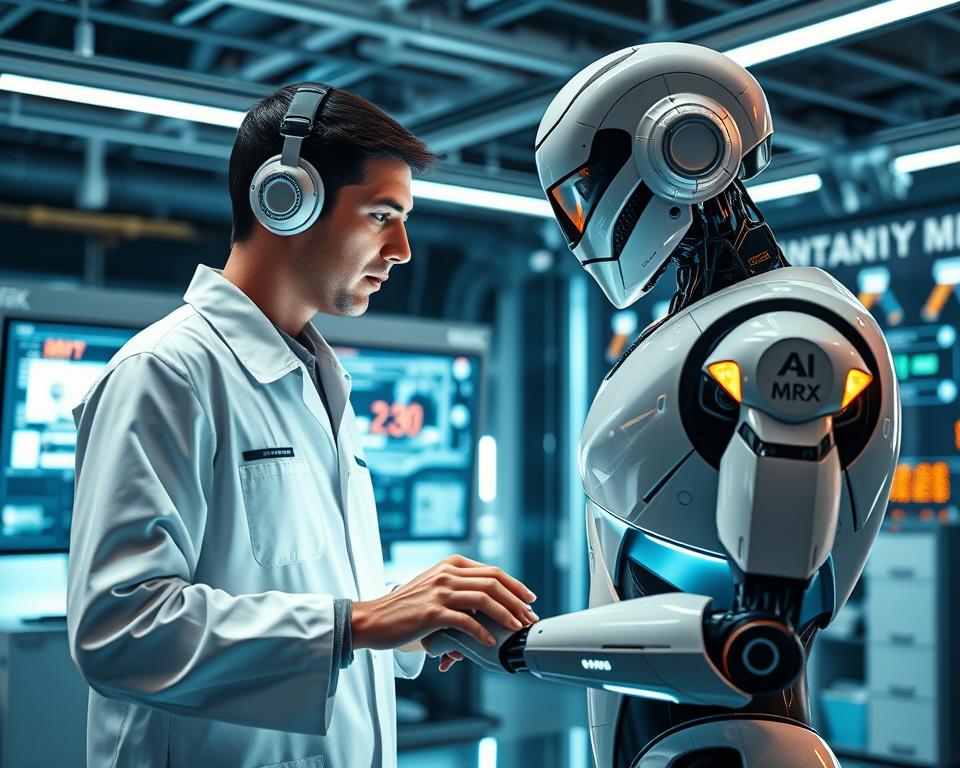
By focusing on these areas, developers can make AI humanoids that are not just useful but also fun and relatable. This opens the door for them to be used in many fields.
Testing and Iteration
Testing and making changes are key to making robotic humanoids work well with people. The journey to perfect an AI humanoid includes many steps. These range from testing prototypes to making design tweaks.
Testing prototypes is a crucial step. It checks how well the humanoid robot works in different situations. This phase finds problems and spots areas for betterment.
Prototype Testing Methods
There are several ways to test prototypes:
- Simulation testing to see how it does in virtual worlds
- Physical testing to check its mechanical strength and how it works
- Studies on how it interacts with people to see if it’s effective
Collecting Feedback for Improvement
Getting feedback is a big part of making an AI humanoid. It involves collecting data from:
- People’s opinions on how it interacts and if it’s easy to use
- Performance data to see how well it does its job
- Technical info to fix any mechanical or software problems
This feedback helps improve the AI humanoid technology. It makes it better at what it does.
Iterative Design Techniques
Iterative design is a loop of making the humanoid better based on feedback and tests. It uses:
- Agile methods for quick changes and updates
- Continuous testing to keep everything working smoothly
- Designing with the user in mind to make it easy and fun to use
Using these design techniques helps make humanoid robots that are not just functional. They are also easy to use and fun to interact with.
Ensuring Safety and Compliance
Ensuring the safety and compliance of AI humanoids is a big challenge. Developers must address this to build trust and reliability. As these robots become more common, their safe operation and following of rules are key.
The making of AI humanoids involves complex interactions. These include mechanical systems, sensor technologies, and advanced software. It’s important that these work together well to prevent accidents and ensure the robots work as they should.
Safety Standards for Robotics
Following safety standards is crucial in AI humanoid development. This means following robotics safety guidelines. These guidelines tell how robots should be designed and operated to reduce risks.
- Implementing fail-safes to prevent accidents
- Conducting rigorous testing under various scenarios
- Ensuring transparent operation and decision-making processes
By sticking to these standards, developers can lower the risk of malfunction. This ensures that artificial intelligence humanoids can safely work with humans.
Ethical Considerations in AI Development
AI humanoid development also raises ethical concerns. These include privacy, autonomy, and job impact.
Developers must think about these ethical issues. They need to create humanoid AI applications that follow rules and respect society’s values and norms.
By focusing on both safety and ethics, developers can make AI humanoids. These robots will be not just functional and efficient but also trustworthy and good for society.
Deployment Strategies
As AI humanoid technology gets better, it’s key to have good plans for using it. This means thinking about how to launch, market, and teach users about AI humanoids. It also involves having plans for support and upkeep.
Best Practices for Launching AI Humanoids
When you launch AI humanoids, you need a smart plan. It’s important to check the environment, decide on user roles, and set clear goals for what the AI humanoid can do.
A good launch plan should also include:
- Looking at risks to find possible problems
- Having backup plans for surprises
- Following safety and rules
Marketing and User Education
Good marketing and teaching users are key to success. Telling users what AI humanoids can and can’t do helps them use it better and feel good about it.
Marketing should focus on:
- Showing the good things about AI humanoids
- Showing how AI humanoids add value
- Creating a community for feedback and help
Support and Maintenance Plans
Keeping AI humanoids working well is important. A good support plan includes updates, fixing problems, and helping users.
| Support Plan Components | Description | Benefits |
|---|---|---|
| Regular Software Updates | Keeping AI humanoids up-to-date and secure | Better performance and safety |
| Troubleshooting | Fixing issues fast | Less downtime and happier users |
| User Support | Helping and teaching users | More confident and using AI humanoids more |
By using these steps in your plan, you can make sure AI humanoids work well in your place.
Future Trends in AI Humanoids
The future of AI humanoids looks bright. New innovations will make them more useful and impactful in society. As tech advances, we’ll see big changes in this field.
Innovations on the Horizon
Several key innovations are coming for AI humanoids. We’ll see better machine learning algorithms for smarter interactions. Also, natural language processing will improve, making communication more natural.
More advanced sensor systems are also on the way. These will help AI humanoids understand and interact with their world better. Expect better vision, touch, and body awareness.

Potential Societal Impact
AI humanoids could change society a lot. They might improve healthcare by offering personalized care. They could also change education with tailored learning experiences. And, they could make customer service more empathetic and personal.
But, there are challenges too. We need to think about ethics and make sure these technologies are used right.
| Industry | Potential Impact | Current Status |
|---|---|---|
| Healthcare | Personalized patient care, assistance in surgeries | Early adoption stages, with some robots assisting in surgeries |
| Education | Personalized learning experiences, interactive teaching aids | Research and development phase, with some pilot programs |
| Customer Service | Enhanced customer experience, 24/7 support | Already being implemented in various industries, with positive feedback |
Collaboration with Other Technologies
The future of AI humanoids also involves working with other tech. For example, combining them with Internet of Things (IoT) devices could make interactions smoother.
Working with augmented reality (AR) and virtual reality (VR) could also bring new opportunities. This could be for training, education, and fun.
Conclusion and Final Thoughts
Building an AI humanoid is a complex yet rewarding task. It combines cutting-edge technology with innovative design. We’ve looked at how to create a sophisticated AI humanoid, from understanding its components to designing its appearance and integrating advanced artificial intelligence.
Key Takeaways
The development of AI humanoids could change many industries, like healthcare and entertainment. By using humanoid AI, developers can make robots that help and interact with humans in a natural way. This guide shows how important the mechanical structure, sensor systems, and software intelligence are for a functional AI humanoid.
Encouragement for Aspiring Developers
Aspiring developers should dive into the world of artificial intelligence and robotics. The field is growing, and AI humanoids could make a big difference in society. By tackling the challenges and opportunities of this technology, developers can help shape the future of human-robot interaction and create solutions that help humanity.
FAQ
What is an AI humanoid?
An AI humanoid is a robot that looks and acts like a human. It has artificial intelligence. This lets it understand language, recognize faces, and make decisions.
What are the primary applications of AI humanoids?
AI humanoids are used in many fields. They help in healthcare, education, customer service, and entertainment. They assist, educate, or entertain people.
What are the key components of an AI humanoid?
An AI humanoid has a mechanical body for movement. It also has sensors for feedback and software for learning. These parts work together for effective interaction.
How do you design the appearance of an AI humanoid?
Designing the look involves aesthetics and ergonomics. It must be both appealing and functional. The design affects how users interact with it.
What technologies are crucial for building an AI humanoid?
Key technologies include AI algorithms and robotics platforms. Programming languages are also essential. These are needed for the humanoid’s functionality.
How are sensors integrated into AI humanoids?
Sensors are used for feedback. They help the humanoid track its position and movement. Different sensors are used for various functions.
What is involved in crafting the AI brain of a humanoid?
Creating the AI brain involves machine learning models and natural language processing. Vision and perception systems are also crucial. These enable complex tasks.
How do you program an AI humanoid?
Programming involves understanding AI workflows and learning algorithms. It also includes developing personality traits based on user input. This lets the humanoid learn and adapt.
Why is testing and iteration important in AI humanoid development?
Testing and iteration are key for refining performance. They ensure the humanoid meets functionality and safety standards. This involves prototype testing and feedback.
What safety considerations are there for AI humanoids?
Safety includes following robotics standards and ethical AI development. This ensures responsible practices.
How are AI humanoids deployed successfully?
Successful deployment involves best practices for launch and marketing. It also includes user education and ongoing support. This ensures effective adoption.
What future trends can we expect in AI humanoids?
Future trends include innovations in AI and robotics. There will be societal impacts and more collaboration with technologies. This will lead to advanced AI humanoids.
What is the role of machine learning in AI humanoids?
Machine learning lets AI humanoids learn from data. This improves their performance over time. It enables more sophisticated interaction and task execution.
How do AI humanoids interact with their environment?
AI humanoids interact through sensors and mechanical structures. This lets them perceive and respond to their surroundings.
What are the benefits of using robotic humanoids?
Robotic humanoids offer assistance, enhance productivity, and provide companionship. They are valuable in various applications.
What are the challenges in developing AI humanoid technology?
Challenges include achieving sophisticated AI and ensuring safety and reliability. Designing user-friendly interfaces is also a challenge. These require ongoing innovation and development.