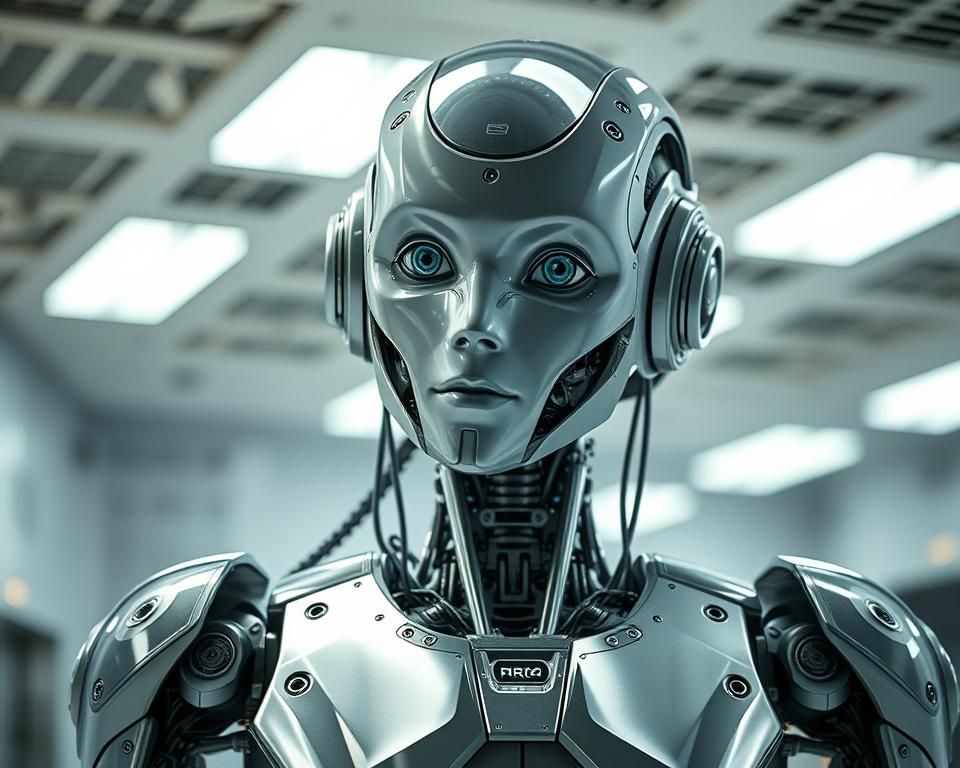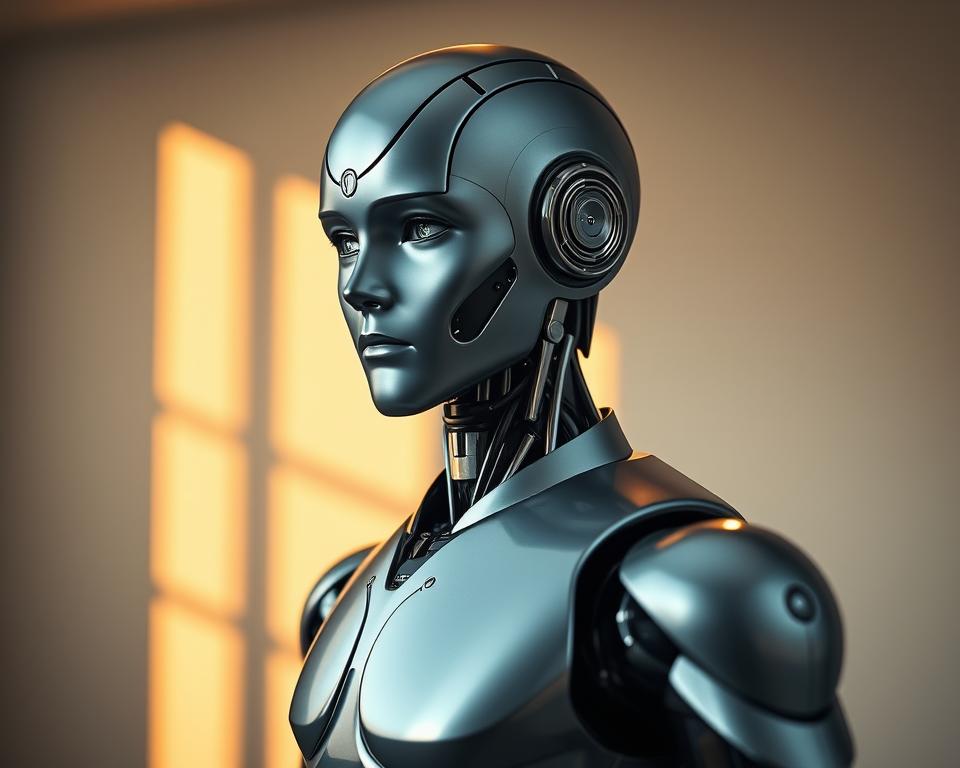
Could realistic humanoid robots soon be so lifelike they change how we see human interaction? Advances in robotics and AI are making machines look and act more like us. This raises big questions about ethics, innovation, and our daily lives.
The rise of androids like Neo from 1X Technologies shows these robots are more than just science fiction. Engineers worldwide are working to make machines that help, work together, and even learn like us. But what if a robot could smile, gesture, and talk like a person?
Realistic humanoid robots use advanced AI, flexible mechanics, and sensors to do tasks like caring for others and helping customers. Companies like 1X Technologies are leading the way, making robots that look and act like people. But, we must ask: How will we adjust to these machines? Can they really be more than just tools?
Key Takeaways
- Realistic humanoid robots merge AI with human-like design to interact naturally in real-world settings.
- 1X Technologies’ Neo exemplifies modern advancements in lifelike robotics and AI integration.
- Ethical debates focus on privacy, job displacement, and the boundaries between human and machine.
- Applications span healthcare, education, and customer service, reshaping industries globally.
- Global innovations in robotics aim to create machines that learn, adapt, and collaborate effectively.
Understanding Realistic Humanoid Robots
Realistic humanoid robots combine advanced tech with a human-like design. These lifelike androids aim to copy human form and function. They drive innovation in many fields. Their creation mixes mechanical engineering with AI to make machines that work in human environments.
Definition and Characteristics
Humanoid robots are made to look and act like humans. They have:
- Mimicking facial expressions and gestures
- Equipped with sensors for environmental awareness
- Powered by AI for adaptive learning and decision-making
Evolution of Humanoid Robots
Over decades, these robots have evolved from simple machines to advanced systems. Here are some key milestones:
| Time Period | Key Features | Examples |
|---|---|---|
| 1950s-1980s | Simple mechanics, limited mobility | Early prototypes like WABOT-1 |
| 1990s-2000s | Improved mobility, basic AI integration | ASIMO by Honda |
| 2010s-Present | High realism, emotional interaction | Sophia by Hanson Robotics |
Modern lifelike androids like Sophia can recognize faces and speak. They show big steps forward from the early days. This shows the ongoing work to make robots more like humans.
Key Technologies Behind Realistic Humanoids
Advanced technologies are key to making humanoid robots work like humans. NVIDIA’s work, like the Isaac GR00T N1 model, shows how AI and robotics come together. These robots use Isaac Lab, a framework that trains them in many scenarios through simulations.
Artificial Intelligence Integration
NVIDIA’s GR00T N1 model has a special AI setup. It has two parts, like our brain, for quick actions and complex decisions. This AI lets robots understand language, see their surroundings, and do tasks like opening doors.
Advanced Robotics and Mechanics
GR00T N1’s design is all about moving like a human. It has joints and actuators that mimic human movements. Working with Google DeepMind and Disney Research, NVIDIA made the Newton physics engine. This helps robots handle objects and adapt to physical interactions.
Sensory and Feedback Systems
Sensors and feedback systems are crucial for robots to sense their environment. Vision language models help them see and understand what’s around them. Touch and motion sensors give them the data they need to adjust. Isaac Lab’s tools train these systems to handle unexpected situations, making them reliable in changing environments.
Notable Examples of Realistic Humanoid Robots
Realistic humanoid robots are big steps forward in creating AI human replica systems. They show the latest tech that’s changing how humans and robots interact.
| Robot | Developer | Core Abilities | Use Cases | Key Milestone |
|---|---|---|---|---|
| Sophia | Hanson Robotics | Facial expressions, conversation AI | Education, public engagement | 2023 Zimbabwe innovation fair participation |
| ASIMO | Honda | Bipedal movement, object recognition | Research, public demos | Retired 2022; tech redirected to avatar robotics |
| Atlas | Boston Dynamics | Autonomous navigation, machine learning | Industrial tasks | 2024 fully autonomous operation achieved |
Sophia by Hanson Robotics
Sophia is an AI human replica that can make faces and talk. She talked about climate change at Zimbabwe’s 2023 tech event. This shows how AI can change global talks.
ASIMO by Honda
ASIMO was the first to walk like a human. Even though it’s retired, its work helps make new robots better. It’s a big part of today’s humanoid tech.
Atlas by Boston Dynamics
Atlas went from needing help to working alone by 2024. It uses sensors and learning to work in factories by itself. This is a big step for AI in real-world use.
Applications of Realistic Humanoid Robots
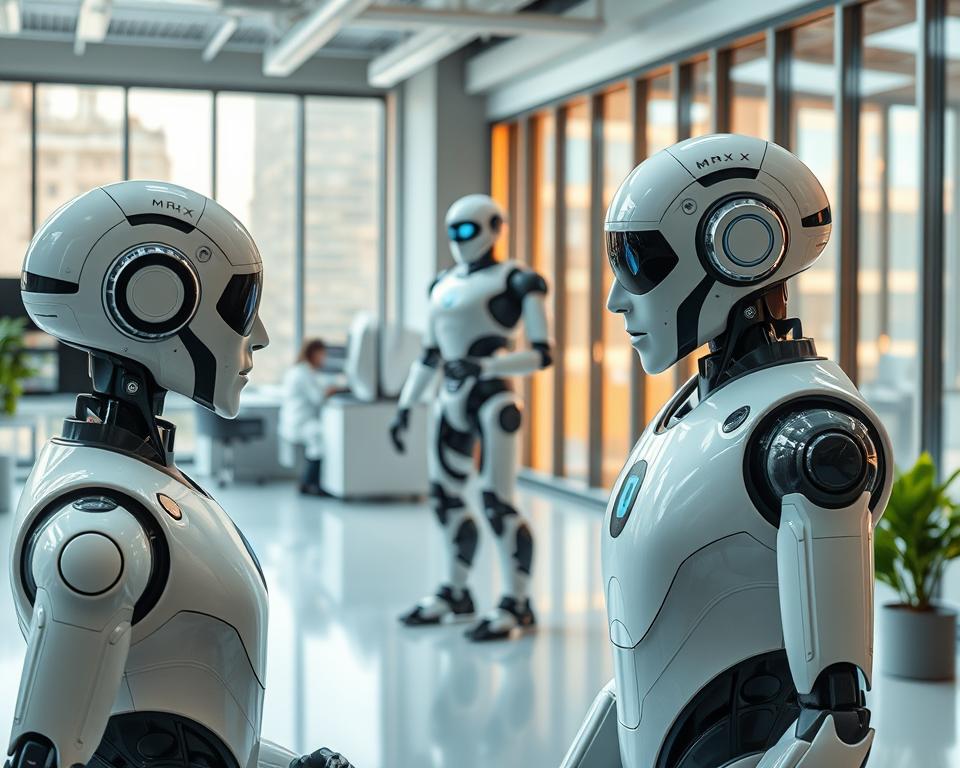
Authentic humanoid robots are changing industries with their human-like skills. They help in healthcare, education, and customer service. This shows their ability to solve real problems and make things more efficient.
Healthcare and Assistance
In healthcare, these robots help with patient care and surgery. They lift patients, give out medicine, and watch vital signs. They also help in surgery and guide patients in rehab.
- Patient care: Lifting, medication distribution, companionship
- Surgical assistance: Precision in operations, reducing human error
- Rehabilitation: Guided exercises and progress tracking
Education and Training
In education, humanoid robots are used to teach STEM subjects and support students. They adjust lessons for each student and help kids with special needs. They also do tasks like tracking attendance, so teachers can focus on teaching.
| Application | Impact |
|---|---|
| Personalized learning | Enhanced STEM engagement |
| Special needs support | Improved communication skills |
| Administrative tasks | Streamlined classroom management |
Employment in Customer Service
Retail and hospitality use humanoid robots for 24/7 service. They answer questions, help shoppers, and manage stock. They learn from data to give personalized advice and do repetitive tasks, making things more efficient and satisfying for customers.
Example tasks include:
- Interactive product demonstrations
- Inventory tracking and restocking
- Real-time customer feedback analysis
From hospitals to stores, these robots are solving labor shortages and improving operations. They show their worth in today’s work world.
Ethical Considerations
As synthetic human tech gets better, we face more ethical problems. Creators must think about how these systems fit into our world. Moral questions come up when machines act like people, making it hard to tell who is who.
“The closer robots approach human-like traits, the more we must question their societal role,” said Dr. Emily Carter, robotics ethicist at MIT.
- Moral Implications: Synthetic humans could challenge cultural norms about consciousness and rights.
- Privacy Risks: Data collected by humanoid robots raises concerns about surveillance and personal information misuse.
- Job Displacement: Industries like retail and healthcare face potential workforce disruptions as robots assume roles.
| Issue | Description | Example |
|---|---|---|
| Morality | Debates over rights and legal status | Sophia’s citizenship controversy |
| Privacy | Monitoring capabilities in public spaces | Facial recognition systems |
| Employment | Job market shifts | Customer service automation |
Companies like Boston Dynamics and Honda need to innovate responsibly. They must create rules to protect workers and user data. Working together, engineers, ethicists, and lawmakers can make sure synthetic humans benefit society.
The Role of AI in Human-Like Interaction
Advances in humanoid AI are changing how robots talk to us. Companies like NVIDIA are leading the way with systems like the GR00T N1. It uses machine learning to understand and reply to our words and feelings.
These systems mix fast processing with feeling awareness. This makes their interactions feel natural and easy.
Natural Language Processing
Natural language processing (NLP) is key to this progress. It lets robots understand context, sarcasm, and cultural differences. Some important features include:
- Real-time voice recognition and response
- Multi-language support for global applications
- Adaptive dialogue to match user personality
Emotional Intelligence in Robots
Emotional intelligence in humanoid AI comes from sensors and algorithms. Here are some main abilities:
| Capability | Technique |
|---|---|
| Facial expression analysis | Computer vision and neural networks |
| Tone detection | Audio pattern recognition |
| Contextual empathy | Hybrid cognitive models |
Collaborations between tech companies and research labs are speeding up these advancements. As humanoid AI systems improve, they will act more like humans. This will change how we get customer service, learn, and get healthcare.
Innovations like NVIDIA’s GR00T N1 show how fast the gap between machines and humans is closing.
Challenges in Creating Realistic Humanoids
Making a realistic robot that can do what humans do is tough. Engineers and designers face many challenges. They need to find a balance between being precise, affordable, and gaining public trust.
Technical Limitations
Today’s tech has big problems:
- Sensors that can’t always keep up with the world around them
- Batteries that don’t last long enough
- Moving like humans, which is hard to do
| Issue | Potential Fix |
|---|---|
| Software delays | Edge computing for faster data processing |
| Material costs | 3D-printed components reducing expenses |
Social Acceptance Issues
Many people are worried about realistic robots taking jobs and invading privacy. A 2023 report found 62% of Americans are unsure about trusting robots in caring roles.
Trying to win people over, companies like Boston Dynamics are letting communities test their robots. This helps ease concerns and build trust.
Future Trends in Humanoid Robotics
New innovations are making humanoid robots smarter and more lifelike. Companies like NVIDIA and 1X Technologies are leading the way. They’re creating systems that let lifelike humanoid machines learn quickly and adapt to changing situations. This is helping to close the gap between how humans and robots behave.
Advancements in AI Capabilities
AI is getting better at making quick decisions. Key improvements include:
- Enhanced machine learning for contextual understanding
- Improved facial and gesture recognition
- Dynamic problem-solving algorithms
Integration with IoT and Smart Homes
Future lifelike humanoid robots will easily connect to smart homes. They can already control lights, security, and climate with voice commands. Companies like Amazon and Samsung are teaming up with robotics firms to make this happen. By 2025, 40% of advanced robots will have IoT features.
The Impact of Realistic Humanoids on Society
Realistic humanoid robots are changing how we interact and live. Experts say these humanoid replicas will soon be in our homes and workplaces. They can act like humans, bringing both good and bad changes.
Care robots might help the elderly, and schools could use them for better learning. This is a big change for all of us.
“These systems aren’t just tools—they’re evolving into partners,” stated a 2023 report by the International Federation of Robotics. This shift demands new ethical and social frameworks to manage human-robot dynamics.
Changing Human-Robot Interaction
- From task-focused machines to adaptive companions
- Emotional engagement in healthcare and eldercare
- New norms for workplace collaboration
Potential for Societal Benefits
Advances promise:
- Improved accessibility for people with disabilities
- Enhanced safety in hazardous environments
- Job creation in robotics maintenance and AI training
Companies like Honda and Boston Dynamics are already using humanoid tech to make things better. But, we must also think about privacy. As these humanoid replicas get smarter, we need to figure out how they fit into our lives.
We need to work together to make sure these changes are good for everyone. Engineers, ethicists, and policymakers must join forces to ensure the benefits are worth it.
Regulatory Landscape Surrounding Humanoid Robots
As humanoid robots get more advanced, governments must create policies that protect people without stopping progress. They often use old laws and adapt them for new tech.
- OSHA standards for machinery safety and workplace hazards apply to robot manufacturing and operation.
- ANSI and ISO guidelines outline safety protocols for industrial robots, focusing on human-robot interaction.
“Prohibiting weaponized robots and restricting devices that harass or restrain individuals, with fines up to $25,000 for violations.”
Recently, Massachusetts passed a 2023 bill to take action. It bans armed robots and limits surveillance. Companies like Boston Dynamics and Agility Robotics also want federal rules. They suggest tax breaks and research funding to help innovation and ethics.
- National strategies aim to align robotics development with ethical AI principles.
- Proposed federal oversight seeks to standardize safety and data privacy rules.
Policymakers need to find a balance between safety and innovation. Clear rules could help robots become more common while keeping people safe. This way, robots can grow in a way that builds trust with everyone.
Research and Development in Humanoid Robotics
Humanoid robotics is advancing fast thanks to new research and development. Big companies and university teams work together. They tackle tough technical and ethical problems.
Leading Institutions and Companies
- Boston Dynamics keeps improving Atlas. They focus on making it move and balance better.
- 1X Technologies creates bipedal robots for jobs in factories and service sectors.
- NVIDIA helps robots learn and make decisions faster with AI and GPUs.
- Universities like MIT and Stanford study how humans and robots interact. They also look into ethical AI.
Significant Research Initiatives
Some major projects are:
- Atlas does parkour to get better at moving over different terrains.
- NVIDIA’s Omniverse lets robots act like humans in virtual worlds.
- Studies at universities focus on robots understanding emotions and following ethical rules.
These projects aim to make robots that help in healthcare, education, and everyday life. They also address big social issues.
Collaborations Between Robotics and Other Fields
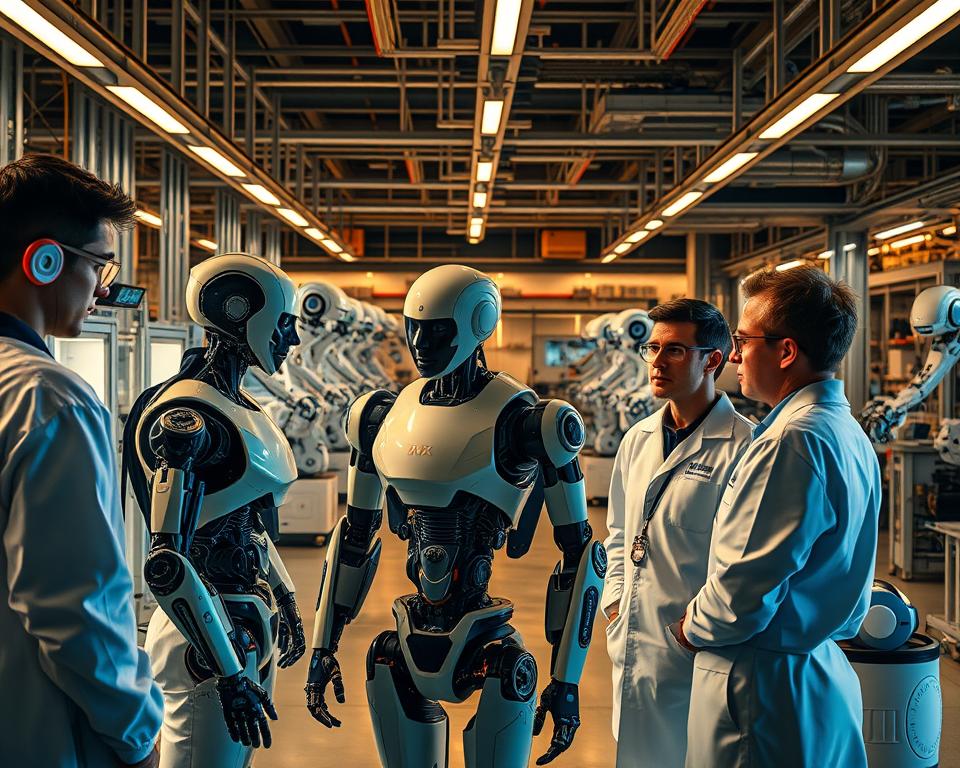
Robotics innovation grows when different fields come together. Teams mix engineering, AI, and creative industries to tackle tough problems. This teamwork leads to smarter, more flexible machines.
Interdisciplinary Approaches
Companies like NVIDIA and Google DeepMind blend robotics with AI. This improves learning and decision-making. For example, Disney Research teams up with engineers to create robots for theme parks. They mix entertainment design with motion control.
This collaboration helps bridge the gap between theory and practical use.
Case Studies of Collaborative Innovations
- NVIDIA’s partnership with robotics startups uses AI tools to improve robot perception and navigation.
- Disney Research’s robot avatars in attractions show how entertainment and tech teams create lifelike interactions.
- Google DeepMind’s work with healthcare providers explores robots aiding patient care through adaptive movements.
“Cross-disciplinary teams turn ideas into breakthroughs,” said a robotics engineer at Disney Research. “Sharing expertise cuts development time and costs.”
Conclusion: The Future of Realistic Humanoid Robots
The journey of realistic humanoid robots has been long, filled with innovation. They use advanced AI, mechanics, and teamwork from different fields. These robots are changing how we use technology, from helping in healthcare to teaching in schools.
Summary of Key Insights
Robots like Sophia and Atlas show big steps forward in movement, AI, and senses. They help with work, learning, and in emergencies. But, there are still big challenges: making sure they act right, keeping our privacy safe, and setting rules for their use worldwide.
The Path Forward for Humanoid Technology
To move forward, we need to keep improving these robots while gaining people’s trust. It’s important to be open about how AI works and to work with laws to set standards. Schools and companies like Boston Dynamics and Honda are key in making these robots better. They help by sharing their findings and testing these robots in real life.
Getting people to accept these robots will also be crucial. We need to teach everyone about them and how they work. This will help as they become more part of our everyday lives.
FAQ
What defines a realistic humanoid robot?
A realistic humanoid robot looks and acts like a human. It uses advanced AI and robotics to interact with people naturally.
How have humanoid robots evolved over the years?
Humanoid robots have changed a lot. They started as simple machines and now are advanced androids. This change is thanks to AI and robotics.
What technologies underpin the capabilities of humanoid robots?
Key technologies include AI for making decisions and interacting. Robotics for movement and agility are also important. Sensory systems help them feel and respond to their environment.
Can you provide examples of notable lifelike androids?
Yes. Sophia by Hanson Robotics is known for talking like a human. ASIMO by Honda is famous for its mobility. Atlas by Boston Dynamics is known for its physical skills.
In what sectors are realistic humanoid robots being utilized?
Humanoid robots help in healthcare, education, and customer service. They assist patients, teach, and improve customer service with human-like interactions.
What ethical concerns surround the development of humanoid robots?
Ethical concerns include the moral questions of creating machines like humans. There are also privacy and data protection issues. Robots might also replace human jobs.
How does artificial intelligence enhance interaction with humanoid robots?
AI makes interactions better through natural language processing. It allows for smooth conversations. Emotional intelligence helps robots understand and respond to human feelings.
What challenges do developers face in creating realistic humanoids?
Developers face technical and societal challenges. They struggle with hardware and software limits. Societal acceptance can also slow down progress.
What are some emerging trends in humanoid robotics?
Trends include better AI for adaptability and intelligence. There’s also more integration with smart homes and IoT. This makes robots more functional.
How are realistic humanoid robots impacting society?
They are changing how we interact. They move from just being useful to offering companionship and collaboration. This could improve life and create new jobs.
What regulatory issues are associated with humanoid robots?
There are many regulatory issues. Discussions focus on privacy, safety, and ethical standards. There’s a need for policies that support innovation while ensuring ethics.
What role does research play in the field of humanoid robotics?
Research is key. It drives progress and innovation. Companies and universities work together to develop new technologies and applications.
How are interdisciplinary collaborations influencing humanoid robotics?
Collaborations between robotics, AI, and entertainment lead to new advancements. They make humanoid robots more advanced and useful, speeding up their development.